
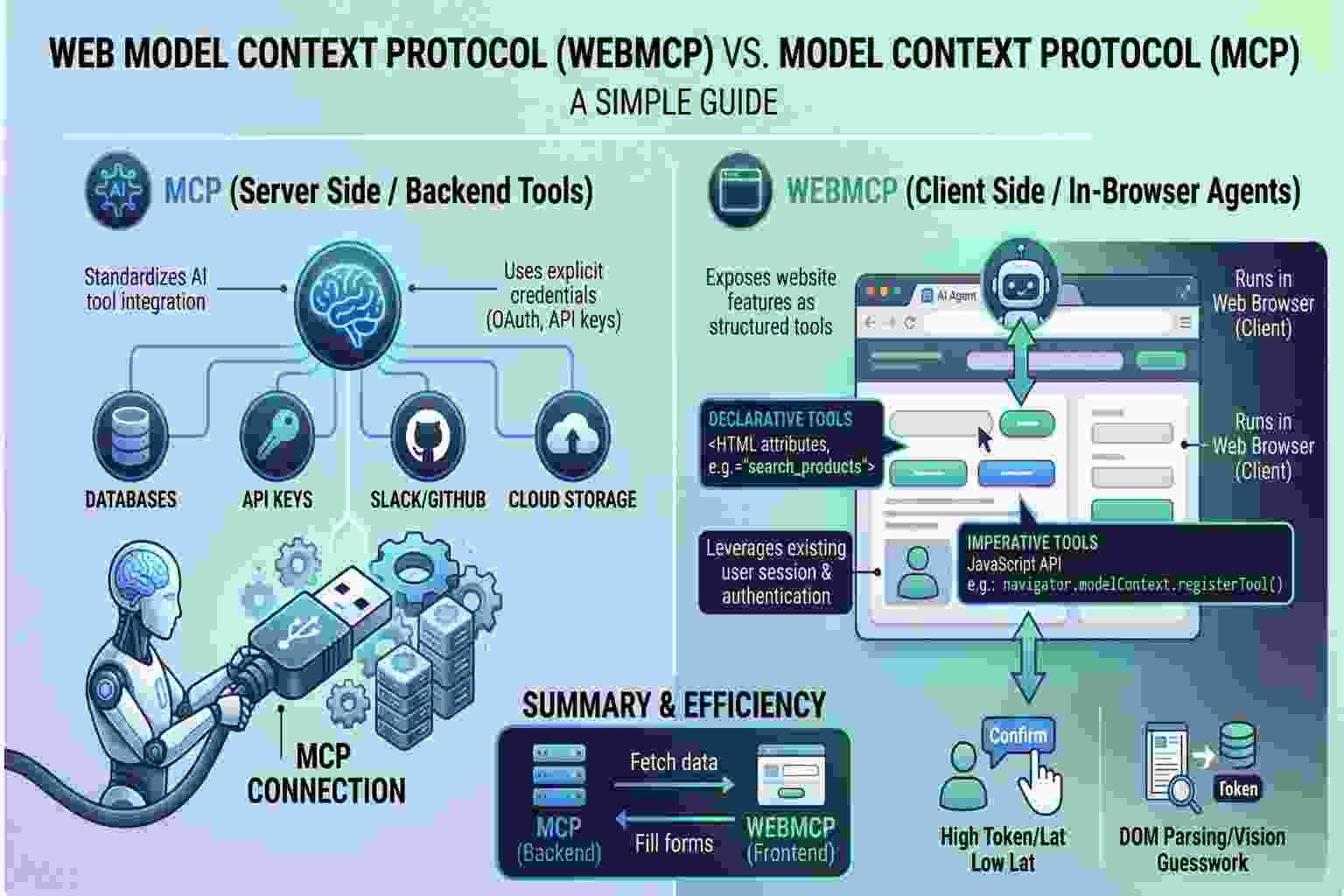
If you have been reading about AI agents lately, you may have come across two similar sounding terms, MCP and WebMCP. They sound alike and both are connected to how AI systems interact with tools and websites, but they are not the same thing. This guide breaks down what each one actually is, in simple language, so you understand exactly where they overlap and where they differ and what this shift means for your own SEO strategy.
What Is MCP?
MCP stands for Model Context Protocol. It was introduced by Anthropic, the company behind Claude, in November 2024.
MCP is an open standard that lets AI models connect to external tools and data sources in a consistent way. Before MCP, if a developer wanted an AI assistant to work with different tools, like a database, Slack, GitHub or a company’s internal files, they had to build a separate custom integration for each one. This created a lot of repeated work, often called the “N times M integration problem,” where N is the number of AI applications and M is the number of tools they need to connect to.
MCP solves this by giving developers one standard way to connect any AI model to any tool. It works using a client-server setup. An MCP client lives inside an AI application, like Claude Desktop and an MCP server exposes the tools, data or actions that the AI can use. Once a developer builds an MCP server for a tool, any MCP-compatible AI application can use it, without needing custom code.
A common way people describe MCP is as a “USB port for AI applications.” Just like USB lets many different devices connect to a computer using one standard port, MCP lets many different AI models connect to many different tools using one standard protocol.
MCP mainly works on the server side, meaning it connects an AI model to backend systems and data sources, not directly to what happens inside a web browser.
What Is WebMCP?
WebMCP stands for Web Model Context Protocol. It is a newer and different standard, first announced on February 10, 2026, developed jointly by engineers from Google and Microsoft under the W3C Web Machine Learning Community Group.
WebMCP is built specifically for the browser. It lets a website expose its own features directly to AI agents as structured, callable tools, using a browser API called navigator.modelContext. Instead of an AI agent taking a screenshot of a webpage and guessing where to click, a website using WebMCP can hand the agent a clear list of what it can do, along with the exact parameters each action needs.
Think of it like a menu. Without a menu, a waiter has to guess what a customer wants. With a menu, the customer can just point and say what they want directly. WebMCP works the same way for websites and AI agents. Building this kind of structured tool contract into a website is a development task, one that fits naturally into the same process as website design and development work.
WebMCP offers two ways for developers to expose these tools:
- Declarative API: simple HTML attributes for actions that are already part of a webpage’s forms.
- Imperative API: JavaScript based tool registration for custom actions, like modals or multi step wizards, that are not simple forms.
As of mid 2026, WebMCP is in a public origin trial in Google Chrome, running from Chrome version 149 through 156. This means developers can test it on real websites with real users, but it is not yet a finished, widely supported browser standard. Right now, Gemini in Chrome is the main AI agent actually using WebMCP tools in practice.
There is also some unclear information about browser support beyond Chrome. Several sources claim Microsoft Edge already supports WebMCP natively, but a direct check of Microsoft’s own Edge release notes did not confirm this as of April 2026. So Edge support should currently be treated as unconfirmed rather than settled fact.
At a Glance: Feature Comparison
| Feature | MCP | WebMCP |
| Execution Context | Backend / Local Server | Browser Active Tab Context |
| Authentication | API Keys / OAuth / DB Credentials | Active Browser Session & Cookies |
| Agent Latency & Cost | Standard API call overhead | Ultra low token footprint (Replaces DOM/Vision) |
| Security Surface | Trusted Server Boundaries | Browser Origin Policies & User Consent Prompts |
| Current Ecosystem | Claude, Cursor, Windsurf, Zed | Chrome / Chromium Origin Trials (Gemini in Chrome) |
WebMCP vs MCP: The Key Differences
| MCP | WebMCP | |
| Introduced by | Anthropic | Google and Microsoft (W3C) |
| Announced | November 2024 | February 2026 |
| Where it runs | Server side, connecting AI models to backend tools and data | Client side, inside the web browser |
| What it connects | AI applications to external tools, databases and systems | Websites directly to AI agents browsing them |
| Current status | Widely adopted open standard | Early stage, public origin trial in Chrome |
| Main use case | Building AI assistants that can access company tools and data | Letting AI agents interact with a website’s own features directly |
The simplest way to remember the difference is this: MCP connects AI models to tools and data behind the scenes. WebMCP connects AI agents to what a website can actually do, right inside the browser, while a person is browsing it.
Are They Related?
Yes, they share a similar underlying idea, giving AI systems a structured way to understand and use tools, instead of guessing. But they were built by different organizations, for different parts of the AI and web ecosystem. MCP is not a requirement for WebMCP to work and WebMCP does not replace MCP. They are designed to work in different layers of the system.
Why This Matters for Website Owners
If you run a website, WebMCP is worth watching, even though it is still experimental. As AI agents increasingly browse the web and take actions on behalf of users, websites that can clearly tell an agent what they can do may become easier for AI systems to interact with correctly.
That said, it is important to stay realistic about where things stand today. As of mid 2026, WebMCP has very limited real world deployment on live websites and only one mainstream AI agent, Gemini in Chrome, is actively using it. This is not yet something you need to rush to implement, but it is a standard worth keeping an eye on as it matures.
Final Thoughts
MCP and WebMCP solve a similar underlying problem, helping AI systems understand and use tools properly, but they operate in different places and were built by different teams. MCP connects AI models to external systems on the backend. WebMCP connects AI agents to websites directly inside the browser. Understanding this difference will help you make sense of where the web is heading as more AI agents start browsing and acting on the internet.
FAQ
What is the main difference between MCP and WebMCP?
MCP connects AI models to external tools and data on the server side. WebMCP connects AI agents directly to a website’s features inside the browser.
Who created MCP and WebMCP?
MCP was introduced by Anthropic in November 2024. WebMCP was announced by engineers from Google and Microsoft in February 2026, under the W3C.
Is WebMCP widely used yet?
No, as of mid 2026 WebMCP is still in an early origin trial in Google Chrome, with very limited adoption on real websites.
Does WebMCP replace MCP?
No, they work in different layers. MCP handles backend tool connections, while WebMCP handles browser-based website interactions for AI agents.


Comments are closed