
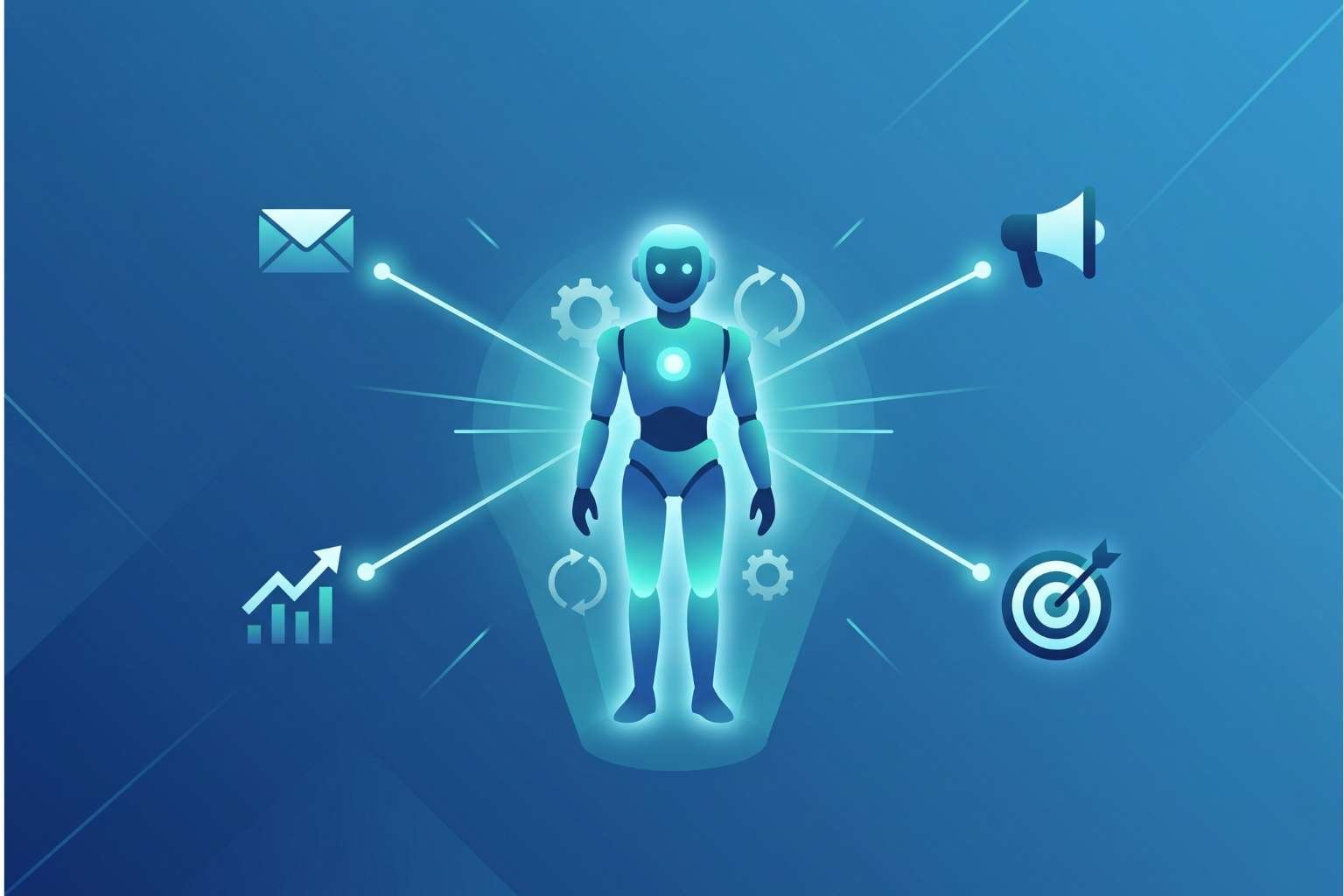
Marketing teams have used automation for years. A tool sends an email when someone abandons a cart. Another tool sends a message after a signup. Agentic AI works differently and it is becoming one of the biggest shifts in marketing in 2026. This guide explains what agentic AI means, how it works and how it is different from the automation tools you may already use.
What Is Agentic AI?
Agentic AI refers to AI systems that can plan, decide and act on their own to reach a goal. They often work across several steps and several tools, without needing constant human instructions.
The basic building block of agentic AI is called an AI agent. An AI agent follows four simple steps:
- It gathers information, such as reading messages, pulling data or receiving updates from other systems.
- It reasons through that information and looks at the context.
- It takes action, like sending an email, updating a database or launching a campaign.
- It reviews the results and adjusts its approach for next time.
In simple terms, a regular AI tool waits for a prompt before it writes an email. Agentic AI can decide on its own that an email needs to go out, write it, send it and check how it performed. No person needs to step in at each stage.
How Is This Different From Regular Marketing Automation?
This is the most important difference to understand. Traditional marketing automation follows fixed rules. It works like a train on a fixed track. If a customer does X, the system sends Y. It cannot think outside those rules.
Agentic AI works differently in four main ways:
- Goal oriented, not rule based. A marketer sets a goal, like increasing demo conversions. The agent figures out how to reach it, instead of following a fixed script.
- Adaptive reasoning. The agent can weigh different options and choose a path based on context, not just one fixed rule.
- Multi system coordination. It can work across several tools and channels at once, not just one workflow.
- Continuous learning. It checks its own results and adjusts its strategy in real time, even while a campaign is still running.
Real Examples of Agentic AI in Marketing
Here are some ways businesses are already using agentic AI:
- Audience segments that update on their own. Instead of a list built once a quarter, an agent studies customer data and behavior and updates the segments continuously.
- Campaign content creation. An agent can write first drafts of emails, landing pages and ad creative. It uses the brand voice, the target audience and past content performance to guide what it writes.
- Mid campaign optimization. An agent can check results while a campaign is still live. It can adjust the approach right away, instead of waiting until the campaign ends.
- Multiple agents working together. In more advanced setups, several agents split the work. One handles data analysis. Another handles content. A third handles channel selection. Together, they work toward one outcome.
How Much Are Businesses Actually Using This?
Adoption is moving fast. Gartner expects 40 percent of enterprise applications to include task-specific AI agents by the end of 2026. In 2025, that number was under 5 percent.
A January 2026 study looked closer at this trend. RevSure and Ascend2 surveyed 306 B2B marketing and revenue leaders across the US and UK. The study found that 76 percent of these organizations were already using agentic AI in marketing, sales or revenue work. Of that group, 41 percent had it fully in place. Another 35 percent were still rolling it out.
Gartner also expects 60 percent of brands to use agentic AI for one-to-one personalized customer interactions by 2028.
Where Humans Still Fit In
Agentic AI is not fully hands off. In most systems used today, people still set the goals. People still decide the creative direction, the budget and the compliance rules. The agent handles the execution, meaning the planning, running and adjusting of the work. People define what success looks like and where the limits are.
Gartner’s research also includes a warning. More than 40 percent of agentic AI projects are expected to fail by 2027. This usually happens because of unclear goals or weak data, not because the technology itself fails. This means agentic AI still needs a clear strategy and solid data to actually work well.
A New Metric Worth Knowing: Share of Model
AI agents are starting to research and recommend products on a person’s behalf. Because of this, marketers are tracking a new kind of metric called “Share of Model.” It measures how often an AI system recommends a certain brand when answering a relevant question. This is similar to how “share of voice” has long been tracked on social media. It shows a wider shift. Brands now need to stay visible to AI systems, not just to human customers. This connects closely to Answer Engine Optimization (AEO).
Should Your Business Be Using Agentic AI Yet?
This depends on your size, your resources and how ready your data is. Larger enterprises are moving fastest. They already run large campaigns and have strong data systems in place.
Most businesses using agentic marketing today are still at an early or middle stage. Humans set the goals and limits. The agent works within those limits. Very few setups today are fully autonomous.
If your business has strong first-party customer data and clear goals, agentic AI tools can genuinely cut down manual work. If your data and processes are not yet organized well, it is worth fixing that first. Agentic AI only performs as well as the data and goals it is given.
Final Thoughts
Agentic AI marks a real shift. AI is no longer just a reactive tool that waits for a prompt. It is becoming a proactive system that can plan, act and adjust on its own toward a goal. Adoption is moving fast, but it still depends on clear human-set goals, solid data and realistic expectations. Understanding this difference now will help you make better decisions about where agentic AI fits into your own marketing. If you want help figuring out where your digital marketing strategy is ready for this shift, get in touch with our team.
FAQ
What is agentic AI in simple terms?
It is AI that can plan, decide and act on its own to reach a goal, across multiple steps, without needing constant human instructions.
How is agentic AI different from marketing automation?
Marketing automation follows fixed rules. Agentic AI sets its own path toward a goal, adapts based on context, works across multiple tools and learns from its own results in real time.
How many businesses are using agentic AI in marketing already?
A January 2026 study found that 76 percent of surveyed B2B organizations were already using agentic AI in marketing, sales or revenue work.
Does agentic AI remove the need for human marketers?
No. Most systems today still rely on humans to set the goals, creative direction, budget and compliance rules. The agent handles the execution.


Comments are closed