
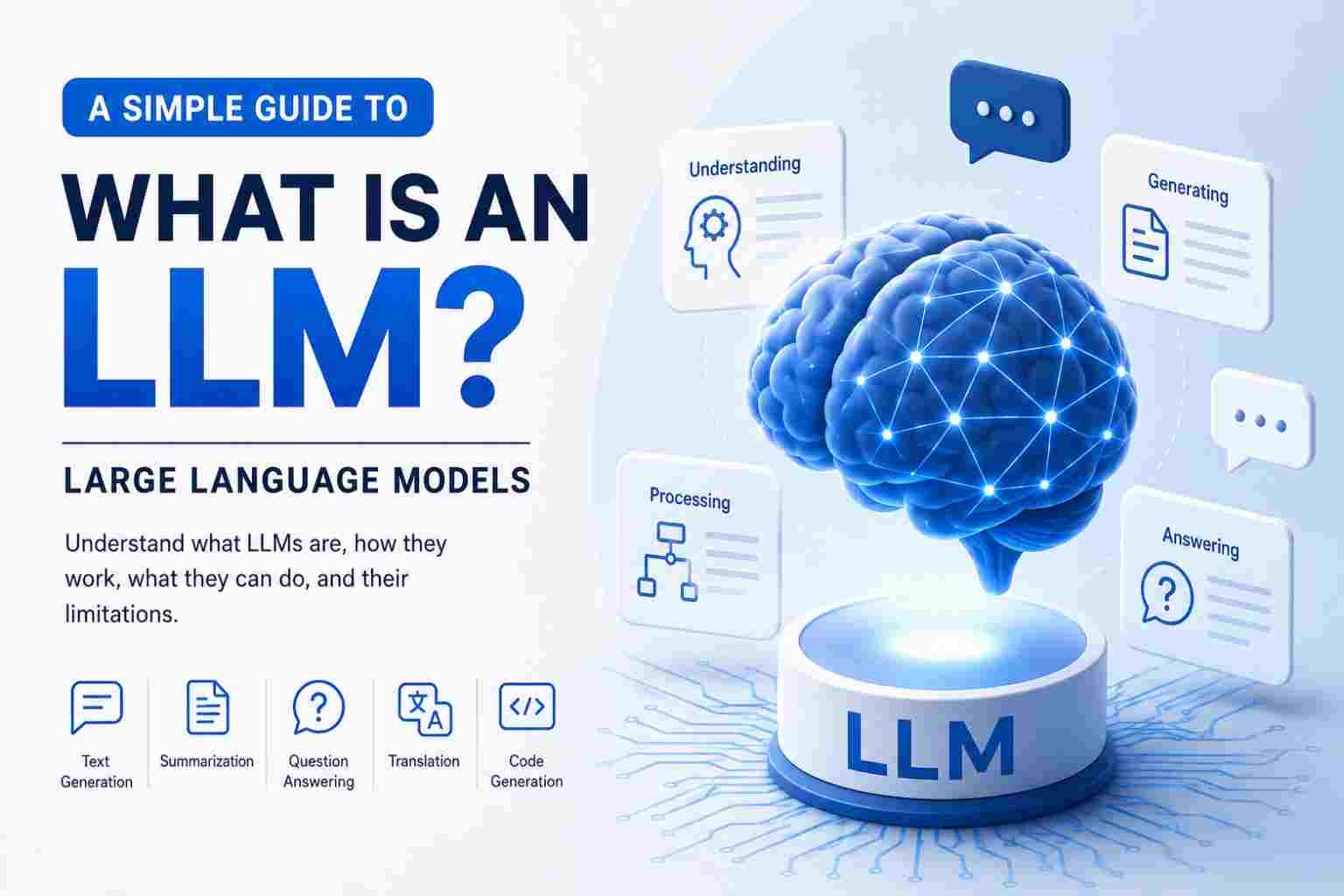
You have probably used an LLM today without even thinking about it. Every time you type a question into ChatGPT, ask Gemini to summarize an email or use Claude to draft a message, you are using a large language model. This guide explains what an LLM actually is, how it works and why it matters for anyone running a website or a business in 2026.
What Does LLM Mean?
LLM stands for large language model. An LLM is a type of artificial intelligence that reads and generates human language. Companies train it on huge amounts of text, including books, websites, articles and code. The model learns grammar, facts and patterns from all this text, then it uses what it learned to answer questions, write content, translate languages and hold conversations.
It helps to know the difference between the model and the app you actually use. GPT, Claude and Gemini are the underlying models. ChatGPT, Claude.ai and the Gemini app are the chat interfaces built on top of those models, the tools you actually type into.
How Does an LLM Actually Work?
An LLM works by predicting one word at a time. Here is the simple version.
First, engineers feed the model trillions of words. This step is called training. The model reads through books, websites, code and articles during this stage.
Next, the model learns patterns from this text. It studies how words connect to each other in sentences. It picks up grammar rules, common facts and even coding conventions along the way.
Then, when you type a question, the model breaks your question into small pieces called tokens. A token can be a whole word or just part of one.
After that, the model predicts the next token based on everything it learned during training. It repeats this step again and again, one token at a time, until it builds a full response.
Most LLMs run on a design called the transformer architecture. This design helps the model track how words relate to each other, even across long pieces of text. IBM describes LLMs as giant statistical prediction machines that repeatedly guess the next word in a sequence, based on patterns they picked up during training.
Why Are They Called “Large”?
The word “large” refers to two things: the amount of training data and the size of the model itself.
Modern LLMs contain hundreds of billions of parameters. A parameter is a numerical value the model adjusts during training to improve its predictions. More parameters generally let a model capture more detail and nuance in language, though size alone does not guarantee better results.
LLMs also handle much more information today than they did just a few years ago. Early versions of GPT-3.5 could only process around 4,000 tokens in a single conversation. Some 2026 models now process over one million tokens in a single session. This expanded capacity lets a model read and respond to much longer documents, conversations or codebases at once.
What Can an LLM Actually Do?
Based on current real world use, LLMs handle tasks like these:
- Answering questions. You ask something in plain language and the model responds based on patterns it learned during training.
- Writing content. Marketing teams use LLMs to draft blog posts, product descriptions and social media captions, though most teams still edit the output before publishing it.
- Writing code. Developers use tools like GitHub Copilot to generate boilerplate code and unit tests, which speeds up routine programming work.
- Summarizing text. An LLM can condense a long document, email thread or report into a short summary.
- Translating languages. Many LLMs handle translation between multiple languages directly within a conversation.
LLMs Are Not Perfect
LLMs have real limitations you should know about.
An LLM can produce answers that sound confident but are factually wrong. This is often called a hallucination in the AI industry. It happens because a base LLM predicts likely sounding text from patterns, rather than checking facts against a live database. Some AI tools, like ChatGPT with Search, Gemini and Perplexity, now reduce this problem by searching the live web first, a method called Retrieval Augmented Generation or RAG, before generating their answer.
An LLM can also repeat biases found in its training data. If the text it learned from contains biased patterns, the model can reflect those same patterns in its answers.
Because of these limits, most companies still keep a human in the loop when using LLM output for anything published publicly, treating the model’s draft as a starting point rather than a finished, ready to publish result.
Why This Matters for Your Website
AI tools like ChatGPT, Gemini and Perplexity now answer questions directly instead of just linking to a website. These tools rely on LLMs to generate their answers. When an LLM decides which website to mention or cite in its answer, it depends on how clearly your content is written and structured.
This connects directly to a practice called Answer Engine Optimization (AEO), which focuses on structuring your website so LLM powered tools can read, understand and cite your content correctly.
Final Thoughts
An LLM is a type of AI trained on massive amounts of text and it works by predicting one word at a time based on patterns it learned during training. It powers the chatbots and AI tools people use every day, from ChatGPT to Claude to Gemini. It still makes mistakes and it works best with human review, but understanding how it works helps you make smarter decisions about your content and your website. If you want help building content that AI tools can accurately understand and cite, get in touch with our team.
FAQ Section:
What does LLM stand for?
LLM stands for large language model, a type of AI trained to understand and generate human language.
What is an example of an LLM?
GPT, Claude and Gemini are examples of large language models that power popular AI chatbots.
How does an LLM generate a response?
An LLM breaks your question into small pieces called tokens, then predicts the next token one at a time based on patterns it learned during training, until it forms a complete answer.
Can an LLM give wrong answers?
Yes. An LLM can produce answers that sound confident but are factually incorrect, since it predicts likely sounding text rather than checking facts against a live database.


Comments are closed