
What Is Marketing Mix Modeling and When Is It Worth It
Quick answer: Marketing mix modeling (MMM) is a statistical method that uses past marketing and sales data to estimate how much each channel contributed to your results. It works with totals such as weekly spend and weekly sales, so it does not need to track individual users. It is most useful for businesses that spend across several channels and need to decide where to put the next rupee of budget.
What Is Marketing Mix Modeling?
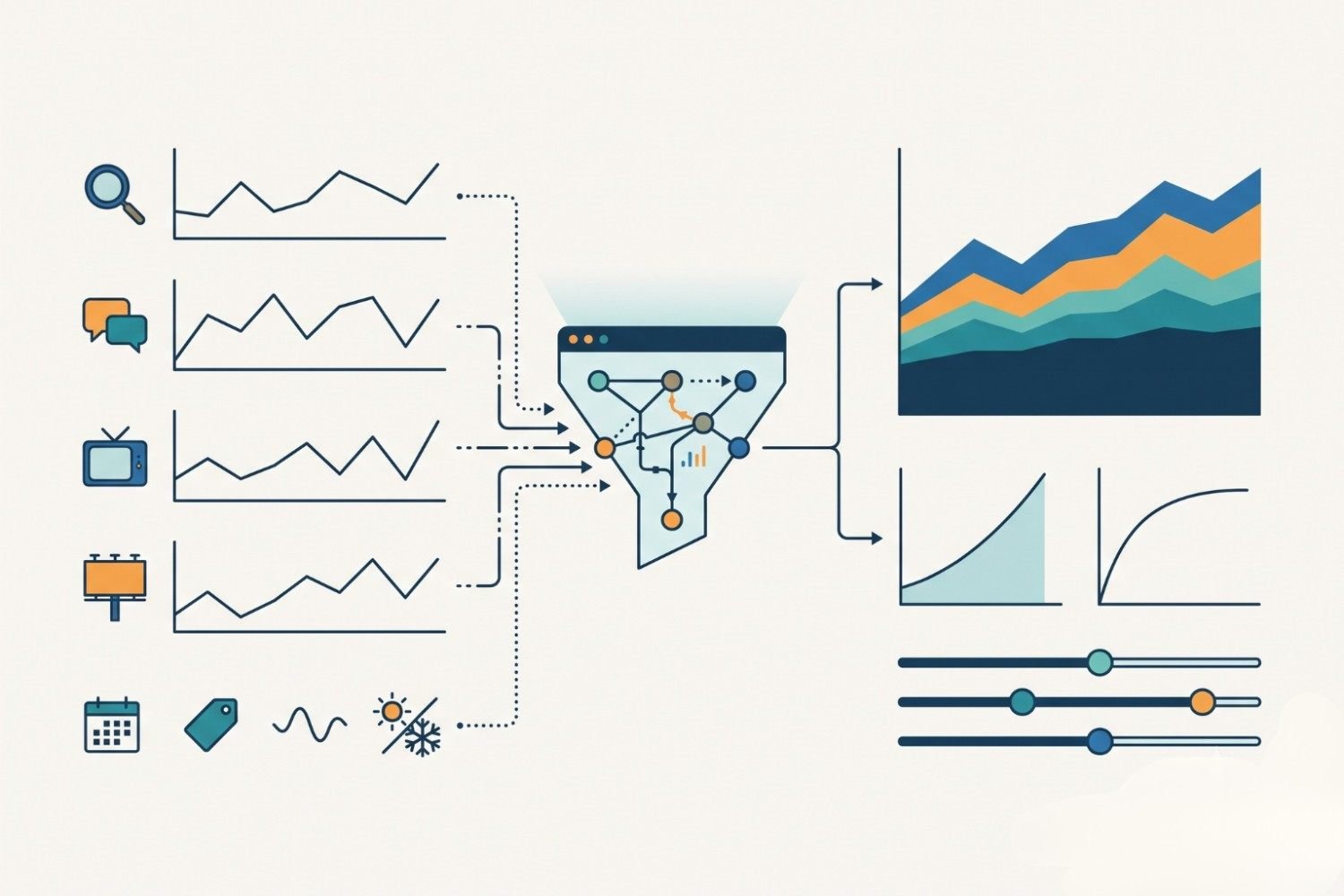
Marketing mix modeling is a way to measure the effect of your marketing on sales. It looks at data over time and uses statistical analysis, usually regression, to separate the effect of each marketing activity from other things that move sales.
Those other things can include seasonality, pricing, promotions, holidays and economic conditions. The goal is to answer a simple question: “If I change my budget on each channel, what is likely to happen to sales?”
MMM has been used for decades, especially by consumer goods companies that sell through stores and run TV, radio and print ads. Today it is also used for digital channels.
How Does Marketing Mix Modeling Work?
The process is easier to follow in four steps.
- Collect data. You gather weekly or daily numbers for sales and for every marketing channel.
- Add outside factors. You include things like seasonality, discounts, product launches and holidays.
- Build the model. The model finds patterns between your spend and your sales over time.
- Read the results. You see how much each channel added to sales and where extra spend gives less return.
The result is an estimate. It is not an exact count of sales per channel.
What Data Do You Need?
MMM uses aggregated data. This means totals over a period of time, not data about one person. Common inputs are:
- Sales or revenue by week
- Spend by channel such as paid search, paid social, TV, streaming, out of home and influencer partnerships
- Impressions or reach where available
- Price changes and discount periods
- Seasonality and holidays
- Competitor activity or market trends where available
If your PPC ads services are run by an agency or an in-house team, ask for weekly spend exports by channel and campaign type. Clean spend data is one of the most important inputs for a reliable model.
Organic search traffic is usually treated as a control variable and not as a spend channel, because it does not have weekly media spend in the same way as paid ads. Email and CRM activity is handled the same way, since its volume depends more on list size than on budget.
Many practitioners suggest at least two years of weekly data so the model can learn seasonal patterns. This is a common guideline and not a fixed rule. More history and more variation in spend usually make the model more reliable.
Key Terms You Should Know
- Baseline sales: Sales that would happen without any marketing, from brand awareness, repeat customers and word of mouth.
- Incremental sales: Extra sales caused by marketing activity.
- Adstock (carryover effect): The idea that an ad can keep influencing buyers for some time after it runs.
- Saturation (diminishing returns): After a point, each extra rupee spent on a channel brings less extra sales than the one before.
- ROI or ROAS by channel: The estimated return from each channel based on the model.
Marketing Mix Modeling vs Attribution vs Incrementality Tests
These three methods answer similar questions in different ways.
| Method | What it uses | Best for |
| Marketing mix modeling | Aggregated historical data | Budget planning across all channels including offline |
| Multi touch attribution | User-level click and journey data | Day to day digital optimization |
| Incrementality tests | Controlled experiments such as holdout or geo tests | Proving whether a specific channel or campaign causes sales |
No single method is perfect. Many teams use MMM for the big picture and use experiments to check its results.
Why Is MMM Getting More Attention?
User-level tracking has become harder. Privacy laws and platform changes, such as Apple’s App Tracking Transparency, have limited how much data advertisers can collect about individuals. Because MMM works with aggregated data, it does not depend on cookies or personal identifiers. This is one of the main reasons it has returned to focus.
Benefits of Marketing Mix Modeling
- It shows the estimated contribution of each channel in one view
- It can include offline channels such as TV, radio and print
- It does not need user-level tracking
- It helps plan budgets by showing where returns are slowing down
- It can show long-term effects and not only quick clicks
Limits of Marketing Mix Modeling
It is useful to know where MMM falls short.
- It needs enough data. Short history or very flat spending makes results weak.
- It shows patterns and not proof. MMM finds relationships in data. Experiments are better at proving cause and effect.
- It is not real time. Models are usually refreshed monthly or quarterly.
- It is less detailed. It is good for channel-level decisions but not for judging a single ad or keyword.
- Results depend on setup. Poor data or wrong assumptions can lead to wrong conclusions.
When Is Marketing Mix Modeling Worth It?
MMM is more likely to be worth the effort when most of these are true:
- You spend across several channels
- You run offline and online marketing together
- Your marketing budget is large enough that small improvements matter
- You have at least a couple of years of clean data
- You need to decide how to split budget between channels
- Platform reports no longer agree with your sales numbers
When Is It Not Worth It?
MMM may not be the right step if:
- You use only one or two channels
- Your budget is small
- Your business is new and has little history
- Your data is incomplete or not tracked properly
In these cases, simple tracking and basic tests, such as turning a channel off for a short time and watching sales, can give more useful answers for less effort.
Tools for Marketing Mix Modeling
Several open-source tools are available. Examples include Google’s Meridian, Meta’s Robyn and PyMC Marketing.
Meridian and PyMC Marketing use Bayesian methods. This lets you add what you already know, such as results from past experiments and update it with your own data. Robyn uses ridge regression and can also be calibrated with experiment results. All three are free to use but need technical skill in data and statistics. Some businesses hire analysts or agencies to build and maintain models.
How to Get Started
- Define the business question, such as “How should we split next quarter’s budget?”
- Collect and clean your sales and spend data
- Fix gaps in tracking before building anything and make sure your seo services and paid campaign data are recorded consistently
- Build or commission a first model
- Check the results against real experiments where possible
- Refresh the model regularly and use it to guide budget decisions
Final Thoughts
Marketing mix modeling will not give you perfect answers but it can give you a clearer view of what drives sales. It works best when you have enough data and several channels and when you treat the results as guidance to be tested. If your business is not at that stage yet, start with good tracking and simple experiments. You can then move to MMM as you grow. If you want support with the channels that feed your data, you can explore our SEO services and ppc ads services pages.
FAQs
What is marketing mix modeling in simple words?
It is a method that uses past sales and marketing data to estimate how much each marketing channel helped your sales.
Does marketing mix modeling use cookies?
No. It uses aggregated data such as weekly spend and weekly sales, so it does not need to track individual users.
How much data do I need for MMM?
Many practitioners suggest at least two years of weekly data. More history and more variation in spend usually help.
Is marketing mix modeling the same as attribution?
No. Attribution follows individual user journeys. MMM looks at overall trends in aggregated data.
Can small businesses use marketing mix modeling?
They can but it may not be worth it if they use few channels or have little data. Simple tracking and basic experiments are often a better first step.
How often should an MMM be updated?
Many teams refresh models monthly or quarterly as new data comes in.
Is MMM accurate?
It gives estimates and not exact figures. Accuracy depends on data quality and model setup. Checking results with experiments improves confidence.

Comments are closed