
Most marketers are using AI wrong. Not because they picked the wrong tool. Not because the technology is not good enough. But because they are not communicating with it properly.
That is the whole game in 2026. The marketers who get exceptional results from ChatGPT or Claude or Gemini are not doing anything magical. They are just giving AI better instructions. That skill has a name: prompt engineering.
And here is the thing nobody tells you upfront. You do not need to be a developer to learn it. You do not need a computer science degree. If you can write a clear creative brief you can write a great prompt. The principles are almost identical.
This guide breaks down exactly what prompt engineering is, why it matters for US marketers in 2026 and how you can start using it to get better results from every AI tool you already have access to.
What Is Prompt Engineering?
Prompt engineering is the skill of crafting instructions that guide AI tools toward producing the output you actually need.
Every time you type something into ChatGPT or Claude or Gemini you are writing a prompt. Most people treat this like a Google search. They type a short vague question and hope for something useful. That approach works sometimes but it is wildly inconsistent.
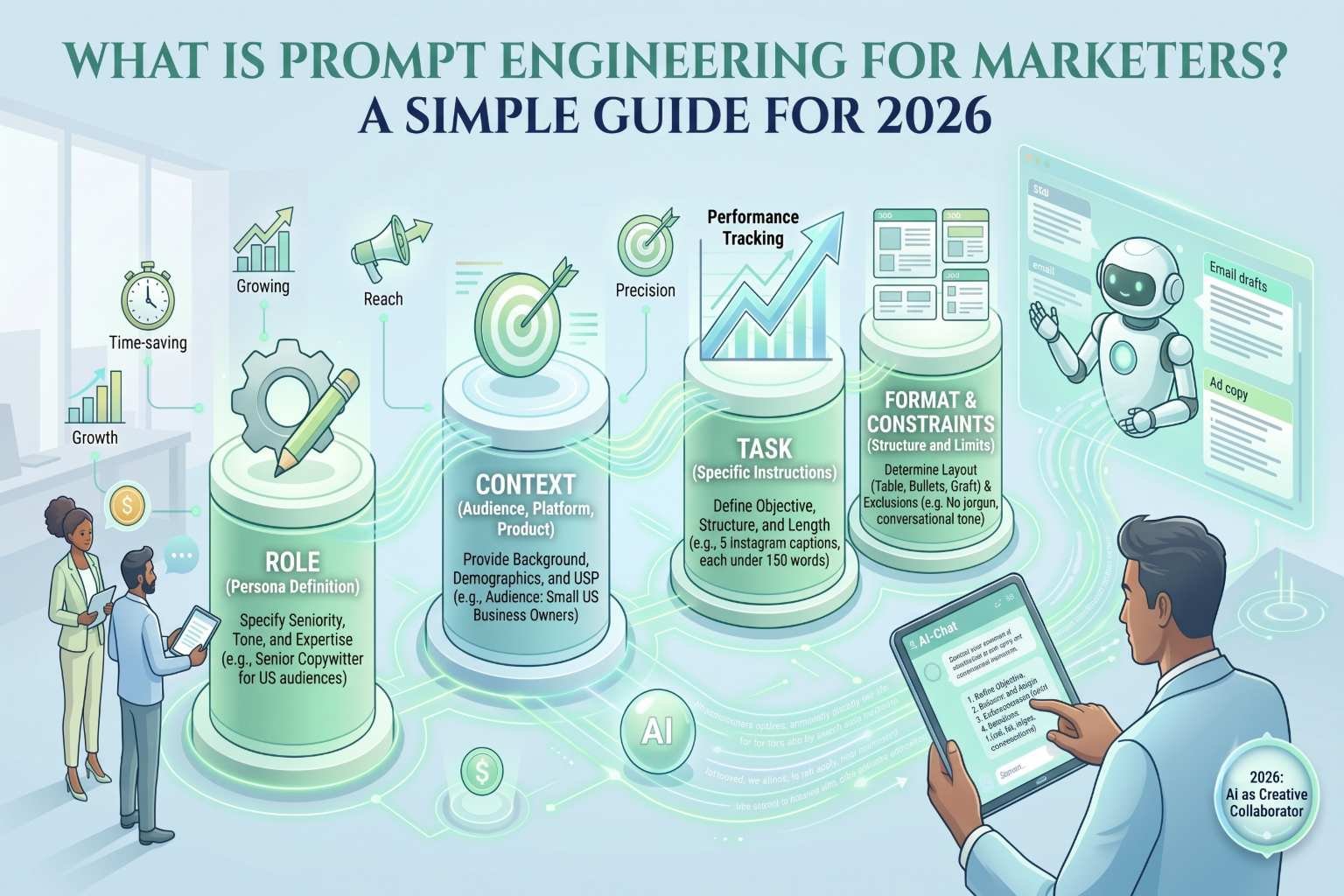
Prompt engineering replaces that guesswork with structure. Instead of hoping the AI figures out what you want, you tell it precisely what you need by defining the role, the context, the task, the format and the constraints before it generates a single word.
The result is dramatically better output every time. According to Gartner prompt specificity increases actionable insights by 40%. That gap compounds fast when you are producing content campaigns and copy every single day.
In 2026 prompt engineering has matured significantly from its early days. It is no longer about memorising magic phrases or gaming the system with tricks. Modern AI models like ChatGPT Claude and Gemini understand natural language deeply. What they need from marketers now is not cleverness. It is clear.
Why Prompt Engineering Is a Core Skill for US Marketers in 2026
AI tools are now embedded in almost every part of a marketing workflow. Content creation. Ad copywriting. Email sequences. SEO research. Social media planning. Audience persona building. Campaign ideation.
Every single one of those tasks produces better results when the marketer behind the prompt knows what they are doing.
For US businesses working with a best ai marketing agency or building an in house team this is no longer a nice to have skill. It is the difference between AI bein g a time saver and AI being a genuine competitive advantage.
Here is what makes 2026 different. AI models have become significantly smarter and more capable. That sounds like it should make prompting easier. In some ways it does. But it also means that vague inputs now produce plausible-sounding outputs that feel convincing but miss the mark completely. The AI fills in your gaps with assumptions. Prompt engineering is what stops that from happening.
The 5 Elements Every Marketing Prompt Needs
Every strong marketing prompt shares the same core structure. Learn these five elements and you can apply them to any task across any AI tool.
Role
Tell the AI who it is before you ask it to do anything. This shapes tone, expertise level and perspective instantly.
Without role: “Write a headline for our app.” With role: “You are a senior copywriter at an ai powered seo services agency with 8 years of experience writing mobile app launch campaigns for US audiences.”
Context
Given the AI background it cannot guess. What is the product? What platform is this for? Who is the audience? What problem does it solve?
The more relevant context you include the more targeted the output. Generic inputs always produce generic outputs.
Task
Be specific about exactly what you want. Vague tasks produce vague results every single time.
Without task clarity: “Write some social media content.” With task clarity: “Write 5 Instagram captions each under 150 words with a strong hook in the first line. Each caption should end with a call to action to visit our website.”
Format
Tell the AI how to structure its response. Do you want bullet points? A table? Three options with labels? A specific word count? Say it explicitly. AI will not guess your preferred format unless you define it.
Constraints
This is the most underused element of prompt engineering and one of the most powerful. Telling AI what NOT to do is just as important as telling it what to do.
“Do not use buzzwords like game changing or revolutionary. Avoid passive voice. Do not make claims that cannot be verified.”
Prompt Engineering in Action: Real Marketing Examples
Here is what the five-element structure looks like applied to actual marketing tasks.
For SEO Blog Content
Basic: “Write a blog about social media marketing.”
Engineered: “You are a content strategist at an ai seo agency India specialising in US market content. Write a 600 word blog introduction for small business owners in the USA explaining why AI powered social media marketing outperforms manual posting in 2026. Use a direct conversational tone. Open with a surprising statistic. Do not mention specific tool brand names.”
For Google Ads
Basic: Write a Google ad for a marketing agency.
Engineered: “Write 3 Google Search Ad variations for a best AI marketing agency targeting business owners in the USA searching for AI marketing services. Each ad needs a headline under 30 characters, a second headline under 30 characters and a description under 90 characters. Focus on results not features. Include a clear call to action in every description.”
For Email Campaigns
Basic: “Write a follow up email.”
Engineered: “Write a follow up email for an ai digital marketing agency to send to a US prospect who downloaded a free SEO audit but has not booked a call. Keep it under 150 words. Reference the audit without being pushy. Include one specific client result. End with a single CTA to book a 15 minute discovery call.”
What Separates Good Prompts from Great Ones
Most marketers figure out the basics of prompt engineering quickly. What separates good from great is iteration.
The first output from any prompt is rarely the final one. Prompt engineering is a conversation not a one shot transaction. When the output is not quite right the next step is specific feedback not starting over.
“Make the tone more conversational” works better than rewriting the entire prompt. “Shorten the intro by half and lead with the statistic” gives the AI something concrete to act on. “Write option 2 again but for a younger audience” builds on what already worked.
This iterative approach is how AI powered social media marketing teams and content agencies are producing high quality output at speed. Not by writing perfect prompts on the first try but by treating AI like a creative collaborator they can direct in real time.
How to Build Prompt Engineering Into Your Marketing Workflow
The most effective US marketing teams in 2026 are not replacing their creative process with AI. They are using AI to accelerate it.
Prompt engineering sits at the start of that process. A well engineered prompt generates a first draft in seconds. The marketer applies judgement, refines the output and moves to the next task. AI handles volume. The marketer handles quality and strategy.
If you work with or are looking for an AI powered SEO services provider or a full service AI agency the best ones will already have structured prompt systems built into their workflows. Content briefs. Campaign frameworks. Ad copy templates. Each one is a pre-engineered prompt designed to produce consistent on brand results at scale.
That is what prompt engineering looks like at the agency level. And it is exactly the skill gap separating marketing teams that are thriving with AI from those still getting mediocre outputs from the same tools.
FAQs
Q1: What is prompt engineering in simple terms?
Prompt engineering is the skill of writing clear structured instructions for AI tools so they produce useful relevant output. Think of it as briefing a very capable team member who needs precise direction to do their best work. The better your brief the better the result.
Q2: Do I need technical skills to learn prompt engineering?
Not at all. Prompt engineering for marketers is a communication skill not a technical one. If you can write a clear creative brief you already have the foundation. The five elements in this guide cover everything you need to get started producing noticeably better AI output right away.
Q3: Which AI tools work best for marketing prompt engineering in 2026?
The three most widely used tools among US marketing teams are ChatGPT Claude and Google Gemini. ChatGPT is strong for versatility and speed. Claude produces excellent long-form content with nuanced tone. Gemini integrates well with Google Workspace and search data. The prompt engineering principles in this guide apply to all three.
Q4: How is prompt engineering different from just asking ChatGPT a question?
A question is a single input with no structure. Prompt engineering is a deliberate approach that defines role context, task format and constraints before the AI generates anything. The consistency and quality difference between the two approaches is significant especially when producing marketing content at scale.
Q5: Will prompt engineering still matter as AI gets smarter?
Yes and the evidence points to it mattering more not less. As AI models become more capable the people who know how to direct them strategically extract even more value from them. Better AI plus better prompts produces dramatically better outputs. Prompt engineering is evolving alongside the technology not becoming obsolete.
Q6: How does prompt engineering help with SEO content specifically?
Prompt engineering allows marketers to produce SEO briefs, outline structures, meta descriptions, FAQ sections and first draft content that is audience aware and search intent aligned from the start. For teams working with an ai seo agency India or running in house SEO this cuts research and production time significantly while maintaining content quality.
Q7: What is the single biggest prompt engineering mistake US marketers make?
Treating AI like a search engine. Short vague inputs produce inconsistent generic outputs regardless of how powerful the underlying model is. The marketers getting the best results from AI in 2026 are the ones giving it rich context, defined role specific objectives and clear constraints. That is the whole difference.

Comments are closed